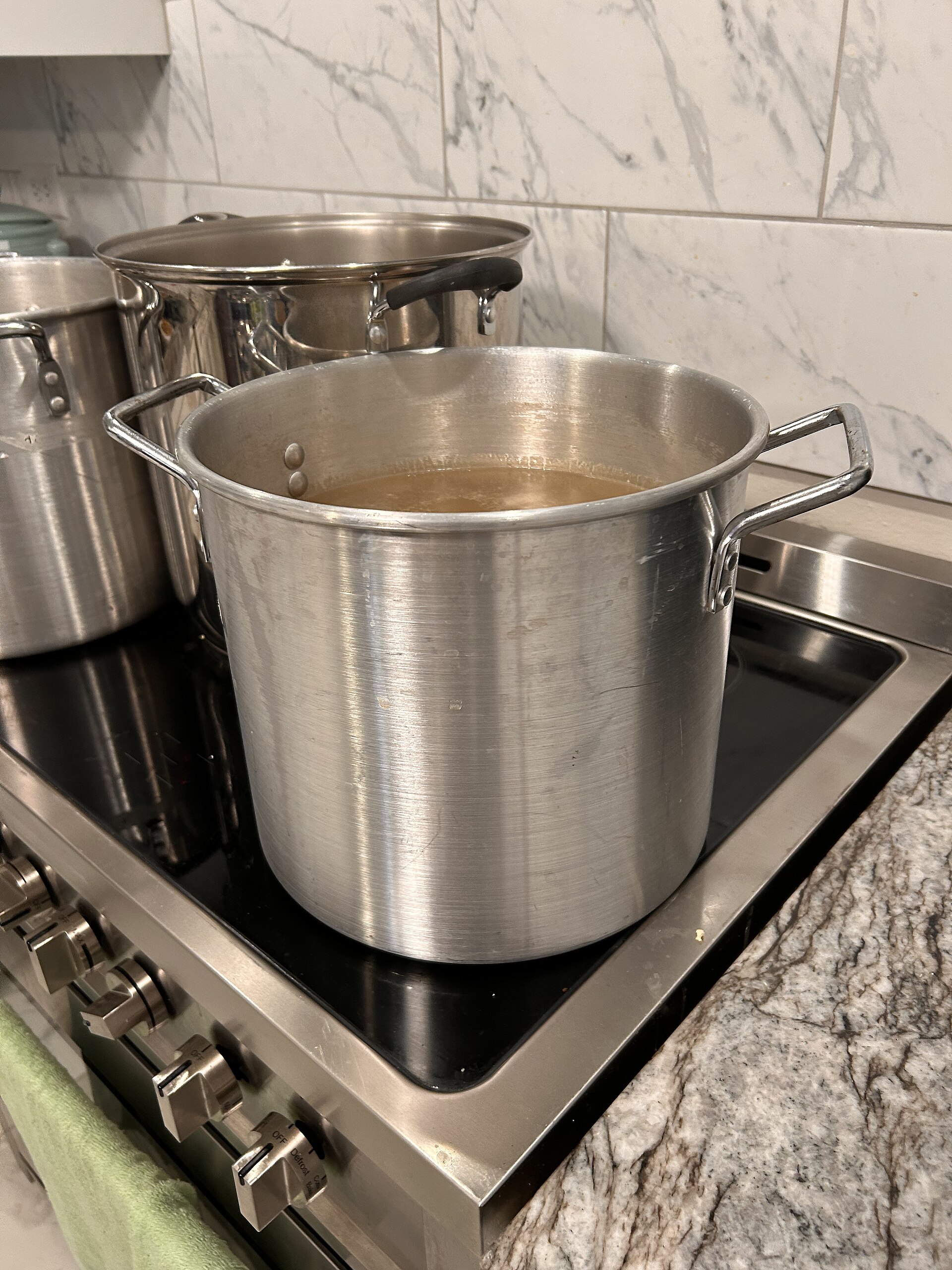
Yes, stock and broth freeze about as well as anything in the kitchen, and I would go as far as to say the freezer is the whole point of making stock in the first place. A chicken carcass and a few tired vegetables become litres of the stuff, far more than any one meal needs, and frozen in sensible portions it turns into the base of risottos, soups, gravies and sauces for weeks afterwards. Homemade stock keeps for three to four days in the fridge and around three to four months in the freezer at its best. The one part worth getting right is cooling it down quickly and safely before it goes in, so let me start there and then get to the portioning tricks that save the most bother.
Free PDF
Free Oven Temperature & Gas Mark Chart
A printable one-page conversion chart for your kitchen: degrees, fan, gas mark and the descriptions in between. Pop your email in and the PDF is yours, plus the odd straight-talking kitchen tip.
Free, unsubscribe any time. The download starts as soon as you sign up.
The short version
Cool your stock quickly, portion it into the sizes you actually cook with, and freeze it. It keeps its quality for three to four months and stays safe for longer. Ice cube trays, muffin tins and flat freezer bags are the three containers that make frozen stock genuinely convenient rather than a frozen brick you resent. Leave headroom, because liquid expands as it freezes. You can drop frozen stock straight into a hot pan in most cases, so there is often no thawing to think about at all.
Cool it down first, and do it fast
This is the one part that is about safety rather than convenience, so it is the one part not to skip. A big pot of stock left to cool slowly on the hob, or slid hot straight into the fridge, spends hours drifting through the warm temperature range where harmful bacteria multiply fastest. The Food Standards Agency guidance is to cool cooked food and get it into the fridge or freezer within one to two hours. Stock is on your side here, because it is thin and watery rather than dense, so it loses heat faster than a stew would, but a deep stockpot still holds its warmth in the middle for a surprisingly long time.
The way to hit that window is to stop treating it as one big vat. Divide it into smaller containers while it is still warm, because a shallow layer sheds heat far quicker than a tall column. Better still, sit the pot in the sink in a bath of cold water with a few ice packs or a bag of ice in it, and stir now and then. The temperature drops noticeably within fifteen or twenty minutes, and from there it is fine to portion and chill. Do not leave warm stock standing on the worktop while you get on with something else, and never put a steaming pot straight into the fridge, because it warms everything else in there. There is more on this in how long you can leave food out.
The portioning tricks that actually help
A litre of frozen stock in one solid block is close to useless. You cannot take half, it takes an age to thaw, and you end up defrosting far more than the recipe wants. The whole art of freezing stock is portioning it so the amount you reach for matches the amount you cook with. These are the three I rely on.
Ice cube trays for small hits of flavour. Each cube is roughly a tablespoon or two, perfect for loosening a sauce, deglazing a pan or adding depth to gravy. Freeze the tray, pop the cubes out once solid, and tip them into a labelled bag so you free the tray up again. I keep a bag of these going at all times and reach for it more than any other.
A muffin tin for medium portions. Each hollow holds around 100 to 125ml, which is a useful splash for a risotto or a one-person soup. Freeze until solid, turn them out, and bag them up the same way. It is the middle ground between a cube and a full tub.
Flat freezer bags for the big portions. Measure in the amount you use for a given dish, half a litre for a soup base, say, seal the bag with the air pressed out, and lay it flat to freeze into a thin slab. Flat slabs stack like files, thaw fast and take up almost no room. Write the quantity and the date on the bag before you fill it, when it is still easy to write on.
Whatever you use, leave a gap at the top of any rigid container, because liquid expands as it freezes and a tub filled to the brim will crack or force its lid off. And label everything. Frozen stock, frozen gravy and frozen soup are near enough indistinguishable once the frost sets in.
How long frozen stock lasts
For the best flavour, use frozen stock within three to four months. It stays safe far longer than that, because anything held properly frozen at minus 18°C is safe more or less indefinitely, but stock slowly picks up stale freezer notes and loses its fresh savoury edge the longer it sits, so a few months is the quality target rather than a safety limit. In the fridge, homemade stock is a different matter: use it within three to four days, or get it into the freezer before then.
Shop-bought stock in cartons or tubs lasts a little longer once opened, usually three to five days in the fridge, partly because of how it is processed. You can freeze that too, exactly as you would homemade, and it is a good way to rescue the half carton left over after a recipe only wanted a splash.
Do you need to thaw it first?
Usually not, and that is the quiet joy of frozen stock. For anything that involves a hot pan, a simmering pot or a sauce, you can drop the frozen cubes or slab straight in and let them melt as the dish heats. A risotto, a soup, a gravy, a braise: all of them take frozen stock without complaint.
The times you want to thaw first are when you need a precise measured amount cold, or when you are adding stock to something that should not be diluted by melting ice. In those cases, move it to the fridge the night before, or sit the sealed bag in cold water for a faster job. Thaw it in the fridge or in cold water rather than leaving it warm on the side, for the same reason you cooled it quickly in the first place. The full method is in defrosting food safely.
Reheat it properly
When you bring stock back to use, heat it until it is properly steaming hot throughout, not just warm. For a liquid that means bringing it up to a rolling simmer. If the stock is going into a dish you will then cook, that happens naturally. If you are drinking it as broth or using it barely heated, make sure it has reached a proper piping-hot simmer first. Reheat any given portion once, not repeatedly, which is exactly why portioning into single uses pays off: you only ever warm up what you are about to eat. I have set out the reasoning in reheating leftovers safely and how many times you can reheat food.
When to bin it instead
Stock is low in acid and rich in exactly the things bacteria like, so treat a doubtful batch with respect. If stock from the fridge smells sour or off, looks cloudy in a way it did not before, has a slick or film that is not just set fat, or fizzes at all, pour it away. The honest limit is that plenty of harmful bacteria leave no smell, taste or visible sign, so a clean sniff is not a guarantee. If a batch sat out too long before you cooled it, or it has been in the fridge longer than a few days, or you simply cannot remember when you made it, do not take the chance. When in doubt, throw it out. That goes double if you are cooking for anyone pregnant, very young, elderly or unwell, where it is worth erring firmly on the cautious side.
None of that should put you off. Stock is one of the most rewarding things to keep in the freezer precisely because it costs so little to make and saves so much. Get the cooling right and portion it sensibly, and the rest looks after itself.
While you are stocking the freezer
Stock is the backbone of so much else that freezes well. The same cool-fast, portion-small approach runs through everything in can you freeze soup and can you freeze gravy, and the two are natural partners to a bag of frozen stock. For the wider picture of what keeps and for how long, freezer storage times is the page I check most.
And if you are making stock in a big batch to fill the freezer, the recipe scaler keeps the ratio of bones, water and aromatics right when you multiply a recipe up, so a double batch tastes as good as the single one, rather than thin and washed out.