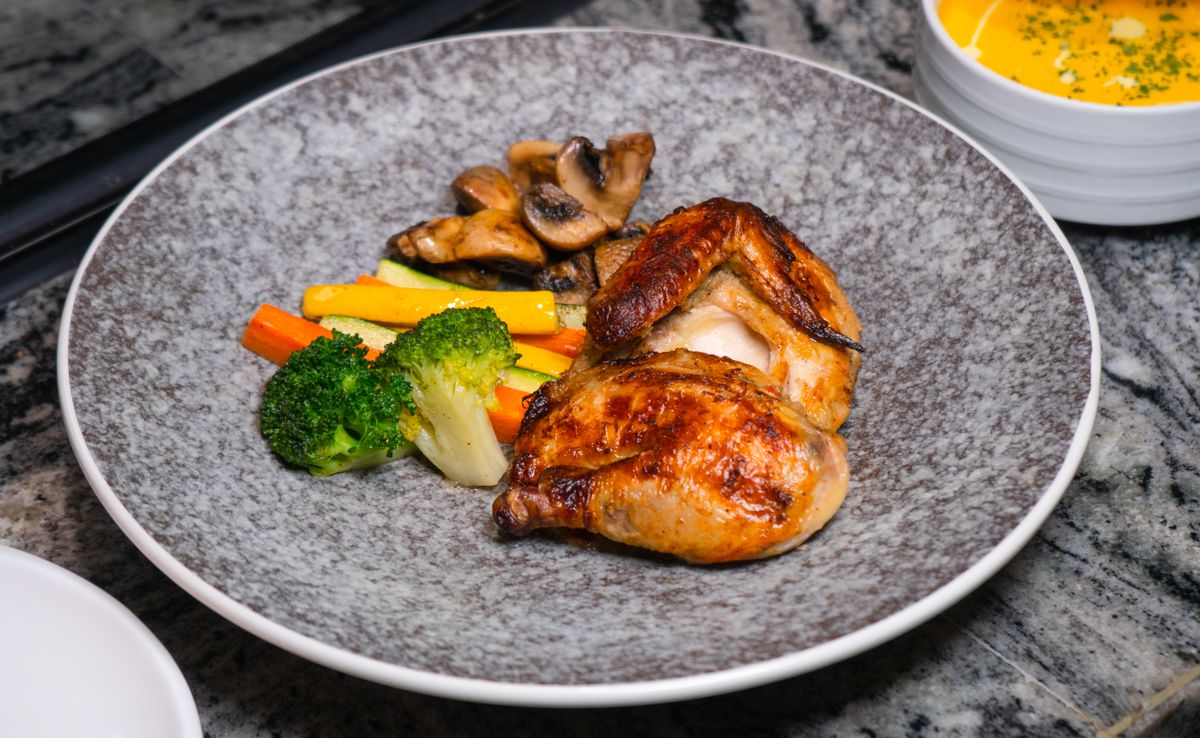
A roast chicken on a Sunday feeds my household twice if I plan it, and the second meal is usually the better one: cold chicken in sandwiches, a quick curry, a pile of it stirred through pasta. So the question of how long cooked chicken really keeps is not academic in my kitchen, it decides what Monday and Tuesday look like. Over the years I have settled into a way of handling it that is safe without being wasteful, and most of it comes down to getting a couple of numbers straight and building two or three habits that then run on their own.
Free PDF
Free Oven Temperature & Gas Mark Chart
A printable one-page conversion chart for your kitchen: degrees, fan, gas mark and the descriptions in between. Pop your email in and the PDF is yours, plus the odd straight-talking kitchen tip.
Free, unsubscribe any time. The download starts as soon as you sign up.
The two-day line, and why the internet says three or four
Here is the first thing that confuses people, because if you go looking you will find two different answers. UK advice and US advice do not quite agree, and both are right within their own framing.
The NHS and UK guidance take the conservative line: eat cooked leftovers, chicken included, within two days. That is the figure I actually cook to, because it is simple, it is safe, and it builds in a margin for the ordinary imperfections of a home fridge that is opened forty times a day.
American guidance from the USDA says cooked chicken keeps three to four days in the fridge. That is not wrong either. The difference is one of caution and assumptions, not a factual dispute. The US figure assumes a reliably cold fridge and good handling throughout; the UK figure leaves more of a safety buffer for the fact that most domestic fridges are warmer and less steady than we like to think.
My rule of thumb: plan for two days, and treat the third and fourth as a stretch that depends entirely on how well the chicken was cooled and how cold your fridge really runs. If I know a batch was cooled fast and my fridge is genuinely at 4C, I will use it into a third day without much worry. But two days is the number I build my week around, and if I am cooking for anyone vulnerable, elderly, pregnant, very young or unwell, I hold that two-day line firmly. The general fridge picture for other foods lives in how long food lasts in the fridge.
Cool it within an hour or two
However many days you decide to allow, the clock only counts if the chicken was cooled and refrigerated promptly. This is the habit that actually protects you, more than the storage time does.
The rule is to get cooked chicken into the fridge within two hours of cooking. That two-hour window is the total time it can safely spend at room temperature, so a chicken that sat out cooling for an afternoon has used up its allowance before it even reaches the fridge, and the two-day clock does not save it. On a hot day, or anywhere warm, I close that gap and aim for nearer an hour, because bacteria multiply fastest in the warm zone between fridge-cold and cooking-hot.
Cooling a whole roast chicken quickly is the tricky bit, because a hot bird holds its heat for a long time. What I do:
- Carve or joint it first. A whole carcass insulates itself and cools slowly. Take the meat off the bone, or at least joint it, and it cools far faster.
- Spread it out to cool. Pieces on a plate lose heat quicker than a heap in a deep bowl.
- Do not put it away boiling hot. Let it cool down first, but do not let cooling become an excuse to leave it out for hours. Cooled to roughly room temperature, then straight in.
- Never seal it while it is steaming. A hot lidded box traps warmth and cools slowly, which defeats the point.
The two-hour figure is not a countdown to panic over. It is just the boundary I keep in mind so that cooling never quietly turns into three or four hours on the side while I am doing something else.
Store it airtight and cold
Once it is cool, cover it well and get it cold. I use plastic boxes with well-fitting lids, which are ideal; failing that, foil or clingfilm wrapped snugly. The aims are to keep it from drying out, to stop it picking up other flavours, and above all to keep any raw juices in the fridge away from it.
That last point matters more than the container. Cooked chicken should sit on an upper shelf, above and away from any raw meat, so nothing can drip onto it. Cross-contamination from raw chicken onto cooked is one of the classic ways a safe leftover becomes an unsafe one, and it has nothing to do with time. And the fridge itself needs to be doing its job: between 0C and 5C. A fridge running at 8 or 9C, which a surprising number quietly do, shortens the safe life of everything in it. If you have never checked yours with a thermometer, it is worth doing once.
The smell test, and where it fails
I use my nose, of course I do. Cooked chicken that has turned often gives itself away: a sour or sulphurous smell, a slippery or sticky, tacky surface, a dull grey colour, sometimes a faint film. Any of those and it goes in the bin, no debate. Trust those signals when they fire.
But here is the limit, and it is an important one. The smell and look tests only catch spoilage, not every kind of food poisoning. Plenty of the bacteria that make you ill do not announce themselves. Chicken can carry enough to give you a rotten couple of days while smelling and looking perfectly fine. So the sniff test is a veto, not a permission: a bad smell is a reliable no, but the absence of a bad smell is not a reliable yes. That is exactly why the dates and the cooling matter, because they protect you against the trouble your senses cannot detect. When chicken is a day past where I am comfortable, I do not sniff it and talk myself into it. I let the calendar decide.
Freezing and thawing
Freezing is how I buy myself real time, and cooked chicken freezes very well. If I know I will not get through it within the two-day window, I freeze it before that window closes rather than at the last gasp. Cooled, portioned, sealed in bags or boxes with the date on, and into the freezer.
For quality it is at its best used within a few months, though frozen food kept properly at a steady freezer temperature stays safe well beyond that; it is texture and flavour that fade, not safety. I flatten bags so they freeze and thaw fast and stack tidily. The wider freezer picture is in freezer storage times.
Thawing is where people slip up, so I keep it dull and safe. I thaw cooked chicken in the fridge, ideally overnight on a low shelf with something under it to catch any drips, never on the worktop where the outside warms into the danger zone while the middle is still frozen. Once thawed in the fridge, I treat it as a normal leftover and use it within a day or so, and I do not refreeze chicken that has been thawed and not cooked again. The full method, including the faster safe options, is in defrosting food safely.
Reheating it once, properly
When I reheat cooked chicken the rule is the same as for any leftover: once, and until it is steaming hot all the way through. In numbers, that means piping hot to the core, 75C if you like a target, which is the UK line for thoroughly reheated food and lines up with the USDA’s 74C for reheated leftovers. Either way it is the same practical test: too hot to eat comfortably, steaming right through the middle, not just warm on the outside.
I reheat only the amount I am going to eat, because reheating the whole batch and putting the remainder back is another warm-up and cool-down the chicken did not need, and I will not reheat the same chicken a second time. In the microwave I stir or turn it partway and let it stand a moment, because microwaves leave cold spots and a cold spot is an unheated spot. Cold chicken straight from the fridge for a sandwich is a different matter and perfectly fine within its two-day life; the reheating rule is only about food you are warming back up. There is more on all of this in reheating leftovers safely.
Batch-cooking safely
I cook chicken in bulk on purpose, so the batch-cooking version of these rules is worth spelling out, because a big batch is where slow cooling quietly goes wrong. A large pot of chicken curry or a tray of poached breasts holds an astonishing amount of heat, and left as one mass it can sit in the warm zone for hours even inside the fridge.
So for a big cook I split it down while it is still warm. Divide it into shallow containers, portion-sized, which cools it inside that all-important couple of hours and has the happy side effect of giving me ready meals. Whatever I will not eat within two days I freeze the same day rather than leaving to run down the fridge clock. And I label everything with the cook date, because by Wednesday I genuinely cannot remember whether the box in the fridge is from Sunday or Monday, and guessing is exactly the habit these rules exist to replace.
The short version
Cooked chicken is one of the most useful things in my fridge and none of this stops it being easy. It comes down to a handful of habits:
- Plan for two days in the fridge. The three-to-four-day figure exists, but two is the safe UK line I build my week on.
- Cool it within two hours, faster when it is warm. Carve it, spread it, do not seal it hot.
- Store it airtight, cold and covered, on an upper shelf away from raw meat, in a fridge at 5C or below.
- Use your nose as a veto, not a green light. A bad smell is a firm no; a clean smell is not a guarantee.
- Freeze before the two days run out if you will not eat it, and thaw in the fridge, never on the side.
- Reheat once, steaming hot to 75C, and only the portion you are eating.
Get the cooling and the storage right and the numbers mostly look after themselves. The chicken goes back to being what it should be, which is two good meals out of one, with no worry attached.