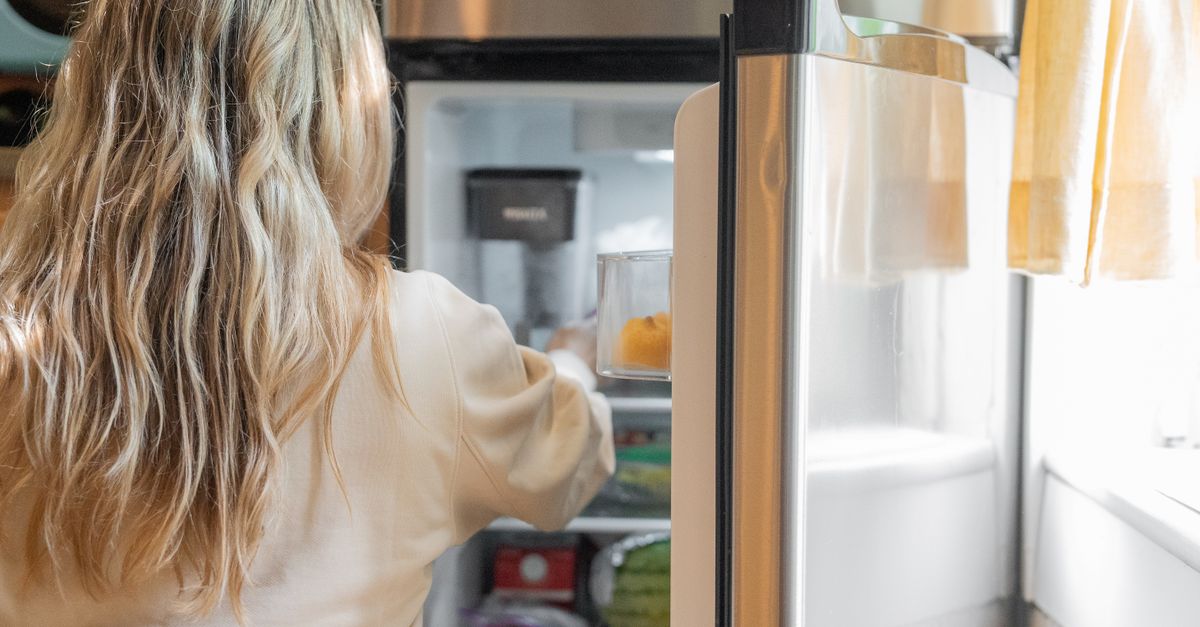
Cooking for five means my fridge is never quiet. Something is always going in, coming out, or lurking at the back in a bowl I meant to deal with two days ago. Over the years I have settled on a set of working rules for how long things keep, and they are not complicated, but they do need to be honest. Fridge storage times are general guidance, not laboratory precision, because your fridge, your kitchen and the food itself all vary. What follows is the widely accepted advice, plus the judgement calls I make daily, stated plainly as judgement calls.
Free PDF
Free Oven Temperature & Gas Mark Chart
A printable one-page conversion chart for your kitchen: degrees, fan, gas mark and the descriptions in between. Pop your email in and the PDF is yours, plus the odd straight-talking kitchen tip.
Free, unsubscribe any time. The download starts as soon as you sign up.
The fridge slows spoilage, it does not stop it
This is the principle everything else hangs off. Chilling food to fridge temperature slows the growth of the bacteria and moulds that spoil food and, more importantly, the ones that can make you ill. It does not kill them and it does not stop them. Given enough days, most things in your fridge will go off, and some of them will become unsafe before they look or smell any different.
That is why storage times exist at all. They are not about the food suddenly turning at midnight on day four. They are a sensible margin, worked out so that under normal conditions the food is still safe when you eat it.
While we are on principles, learn the difference between the two dates on packaging, because they mean very different things:
- Use by is about safety. It appears on perishable food like fresh meat, fish and ready meals. Food can be unsafe after this date even if it looks and smells fine. I treat use-by dates as real limits, not suggestions.
- Best before is about quality. It appears on things like biscuits, tins, dried pasta and frozen food. After this date the food may be past its best, a bit stale or faded, but it is not automatically unsafe. I ignore best-before dates on dry goods fairly cheerfully and use my eyes and nose instead.
Confusing the two leads to both kinds of mistake: binning perfectly good crackers, and eating chicken that should have gone in the bin.
How long things keep: the working numbers
These are the generally accepted ranges for a properly cold fridge. Treat them as guidance, and if the packet says otherwise, the packet wins.
Cooked leftovers: roughly 3 to 4 days. This covers most home cooking, stews, curries, roast meat, pasta bakes, cooked vegetables. In our house leftovers rarely survive that long anyway, but when I batch cook I write the date on the lid and anything at day four gets eaten that day or frozen. Note the clock starts when you cook it, not when you finally get round to noticing it.
Raw poultry and mince: 1 to 2 days. Chicken, turkey and any minced meat (beef, pork, lamb) are the short-fuse items. Mincing exposes a huge surface area to bacteria, and poultry carries its own well-known risks. I buy these close to when I plan to cook them, or freeze them the day they come home.
Raw red meat cuts: 3 to 5 days. Whole cuts of beef, pork and lamb, like steaks, chops and joints, last longer than mince from the same animal because the inside of an intact muscle is essentially sterile. Vacuum-packed meat often carries a longer use-by date, and again, the date on the packet is the one to follow.
Fish and shellfish: 1 to 2 days. Fresh fish waits for no one. If I am not cooking it the day I buy it or the day after, it goes straight in the freezer. Smell matters here more than almost anywhere: fresh fish should smell of the sea, not of fish. Once it is cooked the window opens up a little, and I have set out the numbers in how long does cooked fish last.
Cooked and cured meats, once opened: a few days to about a week. Sliced ham, cooked chicken pieces and similar deli items are usually best within 3 to 5 days of opening. Cured products like salami and chorizo last longer, but “cured” does not mean “immortal” once the packet is open. Check the label, because “eat within X days of opening” is printed there for a reason.
Dairy. Milk usually keeps a few days past opening if the fridge is properly cold; your nose will tell you when it turns, and soured milk is unpleasant rather than dangerous. Hard cheeses like cheddar and parmesan keep for weeks, and a small spot of surface mould on a hard cheese can be cut away generously (a couple of centimetres around it) because the mould cannot penetrate far into the dense paste. Soft cheeses are the opposite: mould on brie, cream cheese or ricotta means the whole thing goes, because soft, moist cheese lets mould spread invisibly. Eggs keep for weeks and carry a best-before date, not a use-by, which tells you something. Keep them in the fridge body at a steady temperature and they will outlast most of what surrounds them. Once they are cooked the timings change, and how long do cooked eggs last covers boiled, scrambled and the rest.
Opened jars and sauces. Pasta sauce, pesto, curry paste, mayonnaise, all of it turns from shelf-stable to perishable the moment you break the seal. Most opened jars want using within a few days to a couple of weeks depending on what they are, and the jar itself tells you. High-sugar and high-vinegar things (jam, pickles, mustard) last far longer than low-acid ones (pasta sauce, pesto). If an opened jar has been sitting so long you cannot remember opening it, that is your answer. And if binning it leaves you short for tonight’s dinner, there is usually a workaround in my list of ingredient substitutions.
Cut fruit and vegetables: 3 to 5 days, covered. Once cut, produce loses its natural protective skin and the clock starts. Half an onion, cut melon, prepped carrots, all fine for a few days in a sealed container. Cut melon in particular should live in the fridge, not on the counter.
Cooked rice: the special case. Rice can carry Bacillus cereus spores that survive cooking and produce toxins if the cooked rice sits warm. The rule I follow: cool cooked rice quickly (within an hour or so), fridge it, eat it within a day or so, reheat it once until piping hot, and never reheat it a second time. The reheat-once principle is worth applying to all leftovers, honestly. Take out the portion you need and heat that, rather than warming the whole pot repeatedly.
Get the temperature right first
None of the numbers above mean anything if your fridge is running warm. The target is 0 to 5°C, and plenty of fridges quietly sit at 7 or 8°C because the dial is set to a vague “3” that corresponds to nothing. A cheap fridge thermometer costs a few pounds and earns its keep within the week. Put it in the middle of the fridge, check it after a few hours, and adjust the dial until you are in range.
Two things worth knowing about the geography inside the box. The door is the warmest spot, because it gets a blast of kitchen air every time anyone opens it, which in a family of five is roughly every ninety seconds. Milk lives in the door in almost every household and it is genuinely the worst place for it; the door is better suited to condiments and juice. And an overstuffed fridge cools poorly, because cold air needs room to circulate.
The freezer is the extender
When a storage time is about to run out, the freezer is how you stop the clock. Freezing halts bacterial growth outright, which is why frozen food carries best-before dates rather than use-by dates. Food kept frozen stays safe more or less indefinitely; what degrades is quality, as ice crystals damage texture and fats slowly go stale. Most things are at their best within about three months, though they remain safe well beyond that.
Most home cooking freezes well: stews, curries, soups, cooked mince dishes, bread, raw meat and fish, grated cheese, blanched vegetables. The poor freezers are the high-water items, so lettuce, cucumber, raw potato and most dairy-based sauces come out sad. Cream and milk can split when thawed, fine for cooking, less fine in coffee.
Thawing is where people get caught out. Thaw in the fridge, overnight or longer, not on the counter, because a joint of meat sitting out all day thaws from the outside in, and the surface spends hours in the warm zone where bacteria multiply fastest while the middle is still frozen. If you are in a hurry, a sealed bag in cold water or the microwave’s defrost setting are the accepted shortcuts, provided you cook the food straight away.
And the refreezing rule: do not refreeze raw food that has thawed at room temperature. Raw food thawed slowly in the fridge can be cooked and then frozen again as a cooked dish, which is a genuinely useful loophole. Thaw mince in the fridge, cook a bolognese, freeze the bolognese. That is fine. The same holds for poultry, and can you refreeze cooked chicken walks through the safe way to do it.
Use your senses, and know their limits
Before anything gets eaten in my kitchen it passes the look, sniff and prod test. Sour or off smells, slimy surfaces on meat, fuzzy mould, milk that has thickened, a jar lid that hisses oddly or bulges: all of these are the food telling you the answer, and the answer is the bin. Trust these signals absolutely when they say no.
But here is the caveat that matters, and it is the one people most want to skip. Your senses can tell you when food is definitely bad. They cannot tell you it is definitely safe. The bacteria that cause food poisoning, salmonella and listeria among them, often produce no smell, no taste and no visible change. Chicken on day five can smell perfectly clean and still make your family ill. This is exactly why the storage times and use-by dates exist: they cover the danger your nose cannot detect. Smell is a veto, never a guarantee. When in doubt, throw it out. The cost of a wasted portion is trivial next to a household of five taking turns with food poisoning.
Habits that actually help
The storage times only work if you can act on them, and in a busy kitchen that comes down to a few boring, reliable habits.
Label with dates. A roll of masking tape and a marker by the fridge. Every container of leftovers gets the date it was cooked. It takes five seconds and ends every “how old is this?” debate permanently.
First in, first out. New food goes to the back, older food comes forward. It is how shops stock shelves and it works just as well at home. The alternative is the archaeology of finding three opened jars of the same sauce.
Cool leftovers quickly. Get cooked food into the fridge within a couple of hours. Spreading it into shallow containers speeds this up enormously, and no, putting warm food in the fridge will not break the fridge. A slightly harder-working fridge beats a pot of stew spending four hours at room temperature.
Raw meat on the bottom shelf. Always, in a sealed container or on a plate with a lip. Raw meat juices dripping onto the salad below is one of the classic routes to cross-contamination, and gravity only works one way. Bottom shelf for raw, upper shelves for cooked and ready to eat.
None of this needs to be precious. It is a handful of numbers, one thermometer, a bit of masking tape and the humility to bin things when you are not sure. That last part is the whole game.
General guidance for a home kitchen, not a substitute for the use-by dates on the packet or your own judgement. If in doubt, throw it out.