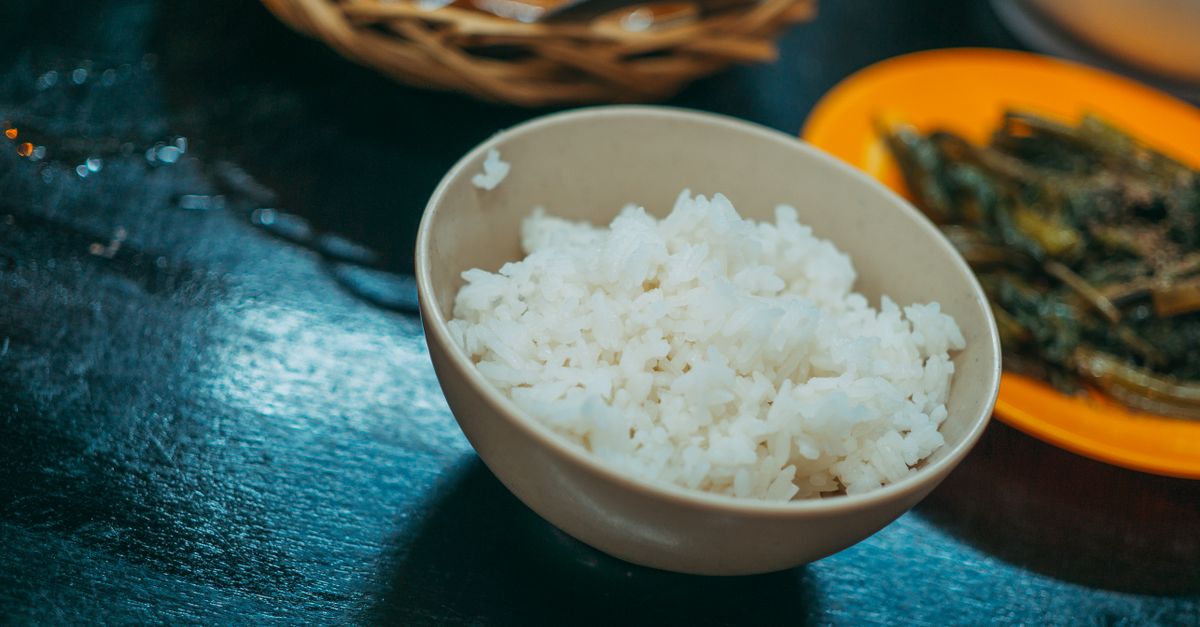
Rice is one of the cheapest foods in the kitchen and one of the most commonly ruined. The packet instructions are often wrong for your pan, the “just double the water” advice is wrong for most rice types, and half the internet insists you need a rice cooker. You do not. You need the right ratio for the rice you actually bought, a lid that fits, and ten minutes of leaving it alone. That last part is where most people fail.
Free PDF
Free Oven Temperature & Gas Mark Chart
A printable one-page conversion chart for your kitchen: degrees, fan, gas mark and the descriptions in between. Pop your email in and the PDF is yours, plus the odd straight-talking kitchen tip.
Free, unsubscribe any time. The download starts as soon as you sign up.
The ratios, by rice type
Measure rice by volume (a mug or measuring cup is fine) and use the same measure for the water. These ratios are for the absorption method, which is the one worth learning.
| Rice type | Water per 1 cup rice | Simmer time | Rest time |
|---|---|---|---|
| Basmati (rinsed) | 1.5 cups | 10 to 12 min | 10 min |
| Jasmine | 1.25 to 1.5 cups | 10 to 12 min | 10 min |
| Long grain white | 1.5 cups | 12 to 15 min | 10 min |
| Short grain / sushi | 1.1 to 1.2 cups | 12 min | 10 min |
| Brown (long grain) | 2 cups | 35 to 40 min | 10 min |
| Wild rice | 3 cups | 40 to 50 min | 10 min |
One cup of dry rice (about 200g) feeds two to three people as a side. If you need to scale a whole recipe up or down around it, the recipe scaler will do the arithmetic for you.
Note that none of the white rice ratios is 2:1. The 2:1 rule that gets repeated everywhere produces soggy basmati every single time. It survives because it is easy to remember, not because it works.
Rinse it first (usually)
Rinsing rice under cold water until the water runs mostly clear removes the loose surface starch that would otherwise turn to glue in the pan. For basmati, jasmine and long grain rice, rinsing is the single biggest improvement you can make. Two or three changes of water in a bowl, or a minute under the tap in a sieve, is enough. You are not trying to achieve laboratory purity.
The exceptions: do not rinse risotto rice (arborio, carnaroli), because the surface starch is exactly what makes risotto creamy. Do not rinse paella rice for the same reason. American enriched rice loses some of its added vitamins when rinsed, but in the UK and Europe this is rarely a consideration.
Soaking basmati for 20 to 30 minutes before cooking gives longer, more separate grains and shaves a couple of minutes off the cooking time. It is a nice refinement, not a requirement.
The absorption method, step by step
- Rinse the rice and put it in a pan with the measured water and a pinch of salt.
- Bring it to the boil, uncovered.
- As soon as it boils, stir once, put the lid on, and turn the heat to the lowest setting your hob offers.
- Simmer for the time in the table above. Do not lift the lid. Do not stir.
- Turn the heat off and leave it, lid still on, for 10 minutes.
- Fluff with a fork and serve.
The two rules that matter are the ones people break: no stirring during cooking (stirring releases starch and makes it gummy) and no skipping the rest. The rest is not optional padding. During those 10 minutes the moisture redistributes from the wet bottom layer to the drier top, and the grains firm up enough to separate. Rice served straight off the heat is wet at the bottom and undercooked on top, and then people blame the ratio.
Boiling: the method for when you don’t care
The alternative is to boil rice like pasta in plenty of salted water and drain it after 10 to 12 minutes. It works, it is nearly impossible to burn, and it is more forgiving of a pan with a bad lid. The trade-offs are real, though: you pour flavour and some nutrients down the sink, the texture is wetter, and jasmine and sushi rice come out noticeably worse. Boiling is a fair choice for long grain rice destined for a rice salad or for feeding a crowd where you need to cook a kilo at once. For everyday rice, absorption gives a better result for the same effort.
Brown rice is the one type where boiling and draining is genuinely competitive, because its cooking time is long and its bran layer stops it going mushy.
Why rice goes wrong
Gummy, sticky mass: unrinsed rice, too much water, or stirring during cooking. Usually all three.
Burnt bottom: heat too high for the simmer, or a thin pan. Use the smallest burner on its lowest setting, and if your pan is very thin, sit it slightly off centre or use a heat diffuser.
Crunchy grains, water all gone: lid does not seal, so steam escaped. Put a sheet of foil or a clean tea towel under the lid. Add a splash of boiling water, re-cover, and give it five more minutes off the heat.
Wet and done at the same time: you skipped the rest. Drape a tea towel over the pan under the lid and wait 10 minutes; the towel absorbs the excess steam.
If a batch has gone properly wrong and dinner depends on it, there are salvage options in how to rescue a dish, but honestly, rice is cheap and takes 25 minutes. Starting again is often the better rescue.
Reheating rice safely
Rice has a genuine food safety issue that most leftovers do not. Uncooked rice can carry spores of Bacillus cereus, which survive cooking. If cooked rice sits at room temperature, the spores germinate and produce a toxin that reheating does not destroy. This is why “reheated rice” gets blamed for food poisoning when the actual culprit is rice that sat out all afternoon before it ever saw the fridge.
The rules are simple:
- Cool leftover rice quickly, ideally within an hour. Spreading it out on a tray or plate speeds this up enormously.
- Refrigerate it and use it within 24 hours. Some guidance says two days; 24 hours is the cautious figure and rice is not worth gambling on. See how long food lasts in the fridge for the wider picture.
- Reheat it once, until piping hot all the way through (above 75°C / 167°F), and do not reheat it again. The general rules for all leftovers are in reheating leftovers safely. A splash of water before microwaving stops it drying out.
- Rice also freezes well: cool it fast, bag it flat, and it keeps for a month or more. Details in freezer storage times.
Yesterday’s chilled rice is actually better than fresh for fried rice, because the grains have dried and firmed up. Just make sure it was chilled promptly and fried until properly hot.
The short version
Rinse it, use 1.5:1 water for most white rice (not 2:1), lowest heat with the lid on, no peeking, and rest it for 10 minutes. Cool leftovers within the hour and eat them within a day. That is the whole trick, and it works on any hob with any pan that has a lid.
This article is general guidance, not professional food safety advice; when in doubt, throw it out.