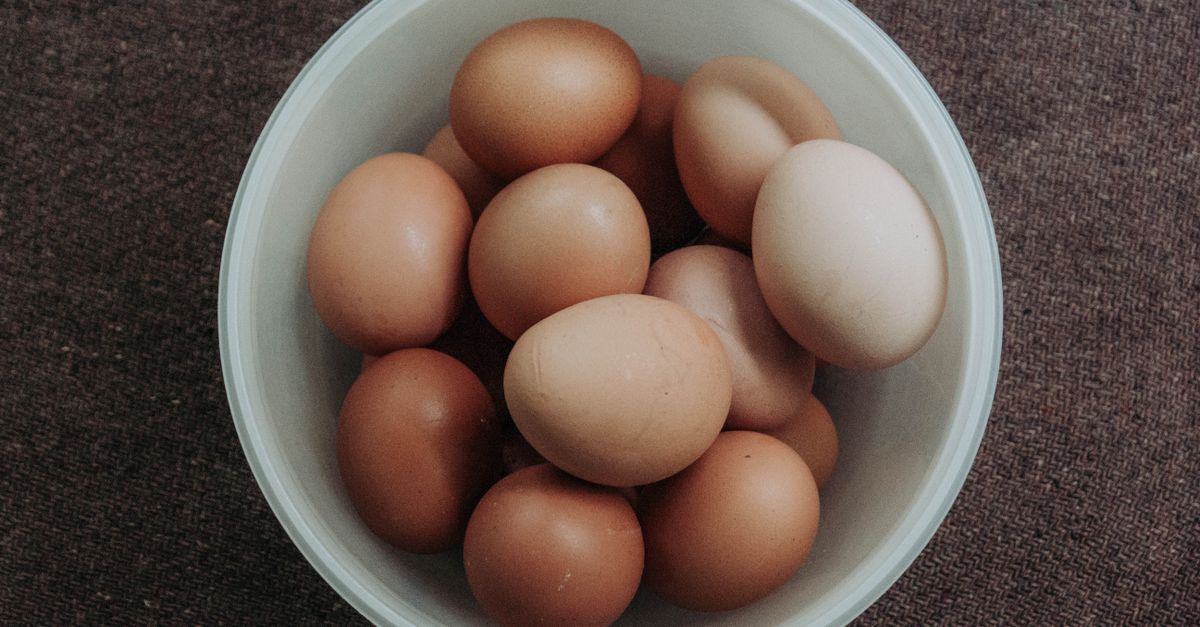
Eggs are one of the few foods where the internet’s favourite freshness trick actually works, sort of, for reasons most articles get wrong. I go through a couple of dozen a week, and every so often a box surfaces from behind the yoghurt with a date that expired while we were on holiday. Here is how to judge them honestly: what the float test really shows, the one test that actually settles the question, and how to store eggs so you rarely need either.
Free PDF
Free Oven Temperature & Gas Mark Chart
A printable one-page conversion chart for your kitchen: degrees, fan, gas mark and the descriptions in between. Pop your email in and the PDF is yours, plus the odd straight-talking kitchen tip.
Free, unsubscribe any time. The download starts as soon as you sign up.
The float test, and what it actually measures
Put the egg in a bowl of cold water:
- Lies flat on the bottom: fresh.
- Stands on its end on the bottom: older, but almost certainly fine. Use it soon, and it will actually peel better hard-boiled than a fresh one.
- Floats: old. Not necessarily rotten, but old enough that I crack it separately and check.
What the float test measures is age, not safety. An eggshell is porous. As the egg sits, moisture and carbon dioxide slowly escape through the shell and air is drawn in, enlarging the air pocket at the wide end. More air, more buoyancy. That is the whole mechanism. A floating egg has a big air cell, which means it has been around a while, and older eggs are more likely to have spoiled. But age and spoilage are not the same thing. A properly refrigerated egg can float and still be perfectly good, and in rare cases an egg can be contaminated without being old.
So treat the float test as a sorting tool, not a verdict. Sinkers go straight in the pan. Floaters get the real test.
The smell test is the real test
Crack the questionable egg into a cup or ramekin on its own, never straight into the batter with five good eggs. A rotten egg announces itself instantly and unmistakably. The sulphurous smell is strong, unpleasant and impossible to talk yourself out of. If it smells of nothing, it is fine. There is no in-between state where an egg smells fine but is dangerously rotten; the bacteria that cause that classic spoilage produce the smell as they work.
While it is in the cup, look at it. A fresh egg has a plump, standing yolk and a thick white that holds together. An old egg has a flatter yolk and a runnier, spread-out white. That is a quality issue, not a safety one. Old-but-sound eggs are poor for poaching and frying (the white spreads everywhere) but fine for scrambling, baking and hard-boiling. Pink, green or iridescent discolouration in the white, or a black or mouldy interior, means the bin, no debate.
The main safety concern with eggs is salmonella, and here is the uncomfortable truth: salmonella has no smell and no appearance. The smell test catches spoilage, not contamination. In the UK, eggs stamped with the British Lion mark come from vaccinated flocks, and the Food Standards Agency considers them low enough risk that runny yolks are fine even for pregnant women and children. Unstamped or imported eggs deserve more caution, meaning thorough cooking, especially for vulnerable people.
Best before, not use by
Eggs in the UK and EU carry a best-before date, set at 28 days from laying, not a use-by date. As covered in the fridge storage guide, best-before is a quality marker, not a safety cliff. An egg does not become dangerous at midnight on the printed date.
The official UK advice is to eat eggs within their best-before date but that they can be eaten a day or two after, cooked thoroughly. My honest domestic practice: refrigerated eggs a week or so past the date get the float-and-sniff routine and are almost always fine, and they go into things that are cooked through, cakes and frittatas rather than soft-poached on toast. That is my judgement call, stated as one. If you are cooking for someone pregnant, very young, elderly or ill, stay inside the date.
Fridge or counter? The UK versus US question
Whether eggs need refrigerating depends on where you bought them, and it is not folklore, it is a real difference in how eggs are processed.
In the US, eggs are washed and sanitised before sale. Washing removes the cuticle, a natural protective coating on the shell, which leaves the pores more open to bacteria. Washed eggs must therefore be refrigerated, continuously, from packing plant to pan.
In the UK and EU, washing eggs for sale is not permitted, precisely so the cuticle stays intact, and salmonella is controlled by vaccinating hens instead. That is why British supermarkets sell eggs off an unrefrigerated shelf, and why your grandmother kept them in a bowl on the side.
Even so, the guidance on the box says to refrigerate at home, and it is worth following. Cool, constant temperatures roughly double how long an egg keeps at peak quality compared with a warm kitchen, and the fridge is the coolest constant place you have. Two refinements: keep them in their box (the shell pores absorb smells, and the box protects them and keeps the date visible), and store them pointed end down, which keeps the air cell at the top and the yolk centred. The door is the warmest, most jostled part of the fridge, so the middle shelf is better, whatever the moulded egg rack in the door suggests.
One genuine counter-argument: cold eggs are worse for baking, where room-temperature eggs whip fuller and combine better with butter. Take them out half an hour ahead, or stand them in warm water for five minutes.
Cracked eggs
An egg that cracked in the box or on the way home has lost its main defence. If the crack is fresh, the membrane is intact and the egg is clean, use it that day, cooked thoroughly. If it has been sitting cracked for an unknown time, or the crack is weeping, throw it away. It is not worth it for the price of one egg.
Deliberately cracked eggs, meanwhile, keep surprisingly well: separated whites keep 2 to 3 days in the fridge and freeze brilliantly, and yolks keep a day or two covered with a splash of water. If a recipe has left you with spares and you are missing something else, the ingredient substitutions guide covers the egg-replacement options too.
Takeaway: the float test tells you an egg’s age, the sniff in a separate cup tells you whether to eat it, and a boxed egg on a fridge shelf will outlast its date comfortably.