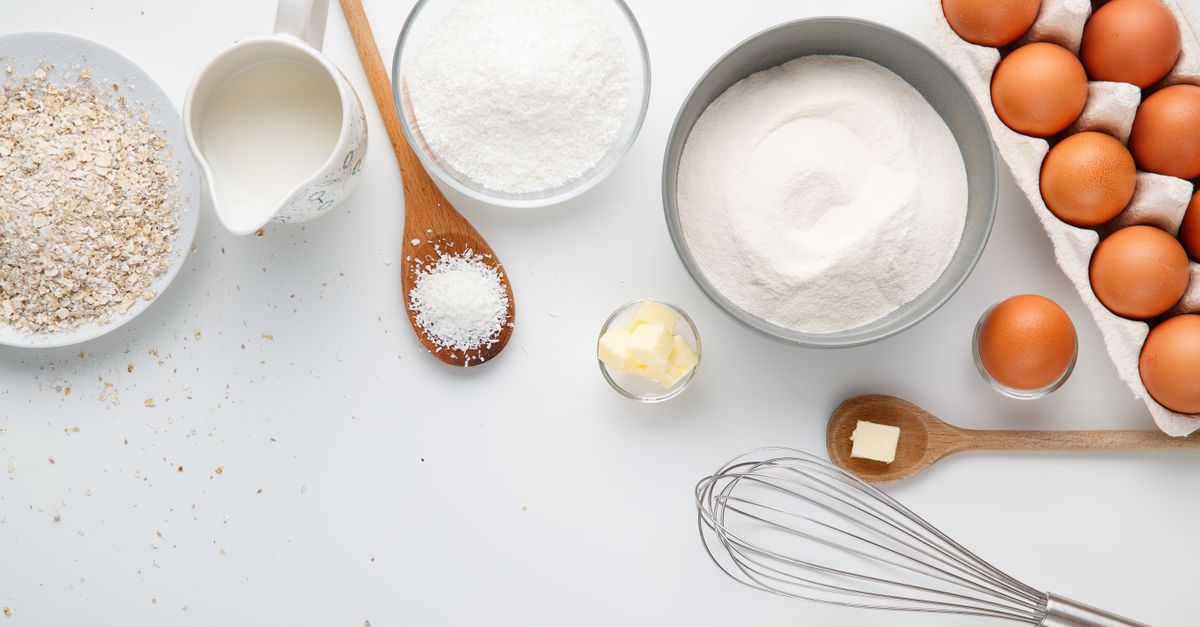
I cook three meals a day for five people, and the shops are a twenty minute round trip I rarely have time for. That means I have run out of something mid-recipe more times than I can count, usually with a bowl half mixed and a child asking when dinner is. Over the years I have learned which substitutions genuinely work, which ones are merely acceptable, and which ones will quietly ruin whatever you are making. This is the honest version of that list. Where a swap has a standard, well established ratio I have given it. Where it is approximate, I say so, because pretending precision where there is none is how bakes get wrecked.
Free PDF
Free Oven Temperature & Gas Mark Chart
A printable one-page conversion chart for your kitchen: degrees, fan, gas mark and the descriptions in between. Pop your email in and the PDF is yours, plus the odd straight-talking kitchen tip.
Free, unsubscribe any time. The download starts as soon as you sign up.
Baking staples, where the stakes are highest
Baking is chemistry, so this is where substitutions carry real risk. Ratios matter, and if you are working between cups, grams and spoons it helps to have cooking measurement conversions to hand before you start improvising.
Buttermilk is the easy one, and the swap is so good I rarely buy the real thing any more. For every 250ml of buttermilk a recipe wants, put 1 tablespoon of lemon juice or white vinegar in a jug and top up to 250ml with ordinary milk. Stir, leave it for five to ten minutes, and it will look slightly curdled. That is correct. The acid is what the recipe actually needs, to react with bicarbonate of soda and to tenderise, and this version does the job in scones, pancakes and soda bread with no detectable difference. Plain yoghurt thinned with a splash of milk works too.
Self-raising flour from plain is another reliable one if you measure properly. The standard ratio is 2 level teaspoons of baking powder per 150g of plain flour, sifted together well so the raising agent is evenly distributed. Whisk it through rather than just stirring once. Going the other way, using self-raising when a recipe wants plain, is riskier. In a sponge you may get away with it if you drop any baking powder the recipe adds. In pastry, sauces or bread it will behave oddly, so I would not.
Baking powder and bicarbonate of soda are not interchangeable, and this is probably the most common way people ruin a bake. Bicarbonate of soda is pure alkali. It needs an acid in the recipe (buttermilk, yoghurt, lemon, treacle, cocoa) to react with, and it is roughly three to four times stronger than baking powder. Baking powder is bicarbonate of soda already blended with a dry acid, so it works on its own. If you have bicarb and cream of tartar, you can make baking powder: 1 part bicarbonate of soda to 2 parts cream of tartar, used straight away. What you cannot do is swap them one for one. Too much bicarb without enough acid gives a soapy, metallic taste and a sad yellowish crumb. I have done it. Nobody ate the cake.
One egg can usually be covered. If the recipe uses several eggs and you are one short, the safest fixes are 3 tablespoons of plain yoghurt, or 3 tablespoons of milk plus half a teaspoon of baking powder, or roughly 60g of mashed banana or apple purée in anything where the flavour suits (banana announces itself, apple hides better). With no eggs at all, 1 tablespoon of ground flaxseed mixed with 3 tablespoons of water and left for ten minutes makes a decent binder per egg, and 3 tablespoons of aquafaba, the liquid from a tin of chickpeas, stands in surprisingly well, especially where the egg is there for lift. Be realistic though. These replace one or two eggs in a muffin or a brownie. They will not carry a sponge that relies on whisked eggs for its entire structure, and nothing replaces eggs in a custard.
Caster versus granulated sugar matters less than the packets suggest. Chemically they are identical; caster is just finer. In anything melted, dissolved or wet (syrups, most traybakes, crumbles) granulated is fine as it is. For creaming butter and sugar, granulated dissolves less readily and can leave a slightly speckled, coarser crumb. Ten seconds in a blender or food processor turns granulated into perfectly good caster, and I do this routinely.
Brown sugar in a pinch: stir 1 tablespoon of black treacle (or molasses) into 200g of white sugar for light brown, 2 tablespoons for dark. Rubbed together with a fork it is genuinely as good as bought. With no treacle at all, plain white sugar will work in most recipes; you lose some moisture and the caramel note, so cookies come out crisper and paler, but they are still cookies.
Dairy and fats
Butter and oil swap in one direction more happily than the other. Where a recipe melts the butter anyway (muffins, many traybakes, pancakes), a neutral oil works well; use about three quarters the weight of the butter, because butter is roughly 80 per cent fat and the rest water. Where the butter is creamed with sugar to trap air, or rubbed into flour for pastry or crumble, oil does not work. Creaming needs a solid fat to hold the bubbles, and pastry needs cold fat in discrete pieces. Going the other way, melted butter can replace oil in most baking at equal weight, and usually tastes better for it. For frying, either is fine, though butter burns sooner, so I add a splash of oil to it for anything over a medium heat.
Cream depends on what the cream is doing. For pouring into a sauce or a soup, whisk about 50g of melted butter into 200ml of whole milk and you have a workable stand-in for roughly 250ml of single cream. Approximate, but it enriches a sauce perfectly well. Evaporated milk straight from the tin also works in cooked dishes. What none of these will do is whip. Whipping needs at least around 35 per cent fat, so for anything piped or folded you need actual whipping or double cream, or a chilled tin of full fat coconut milk if the flavour suits.
Soured cream and crème fraîche are near enough interchangeable with each other in most cooking, and full fat Greek yoghurt stands in for either on top of chilli, in dips, or dolloped on soup. In hot dishes, crème fraîche is the most stable, soured cream next, and yoghurt splits most easily, so with yoghurt take the pan off the heat before stirring it through, or steady it first by mixing in a teaspoon of cornflour.
Milk is the most forgiving of the lot. Half and half evaporated milk and water works. In most baking and sauces, oat or soya milk substitute directly with little change; oat is the closest in behaviour for white sauces. Dairy runs out fast in this house, and knowing how long food lasts in the fridge has saved me more than once from binning a carton that was actually fine, or trusting one that was not.
Aromatics and seasoning
Fresh and dried herbs convert at roughly one to three: 1 teaspoon of dried for every tablespoon of fresh. Dried herbs are concentrated but they need cooking time to soften and release, so add them early. This works well for the sturdy herbs, thyme, oregano, rosemary, bay, sage. It works poorly for the delicate ones. Dried basil, parsley and coriander leaf are pale shadows of fresh, so in those cases I would rather change the dish slightly than use the dried version and pretend.
Garlic in any form beats no garlic. One fresh clove is roughly a quarter teaspoon of garlic granules or powder, or half a teaspoon of garlic paste from a jar. The jarred and dried versions lack the sharp raw edge, which for a slow-cooked sauce hardly matters. For onion, a teaspoon of onion granules stands in for a small onion in a pinch, or a leek or a couple of shallots substitute properly. A few of the white parts of spring onions, softened gently, will rescue a sauce base too.
A missing stock cube is mostly a missing hit of salt and savouriness, and you can rebuild that. A teaspoon of Marmite, a splash of soy sauce, a spoon of miso, or a parmesan rind dropped into the pot all do the job in soups, stews and gravies. Adjust the salt afterwards rather than before, because all of these are salty themselves.
Lemon juice and vinegar cover for each other in cooking more often than not, because frequently what the dish wants is simply acid. In a dressing, marinade or pan sauce, swap them roughly one for one and taste. White wine or cider vinegar is closest to lemon; malt vinegar is too blunt for most of these jobs. Where lemon is a front and centre flavour, in a lemon drizzle or a lemon butter sauce, vinegar is not a substitute and it is better to make something else.
Thickeners
Cornflour and plain flour both thicken, but differently. Cornflour has about twice the thickening power of plain flour, so 1 tablespoon of cornflour does the work of roughly 2 tablespoons of flour. Mix it to a slurry with a little cold water first, stir it into the simmering liquid at the end, and it thickens almost instantly to a glossy, slightly translucent finish. Good for stir fry sauces, gravies rescued at the last minute, and fruit fillings. It does not hold well through long cooking or reheating, and it can loosen again if boiled hard.
Plain flour and a roux suit anything that cooks for a while. Equal weights of butter and flour cooked together for a couple of minutes, then the liquid added gradually, gives an opaque, stable, rounded sauce: white sauce, cheese sauce, the base of a stew. Flour needs those few minutes of cooking or it tastes raw and pasty, which is exactly why the slapdash version, dusting raw flour straight into a wet stew, disappoints. If you must thicken an already-made liquid with flour, mash it into soft butter first and whisk that in bit by bit. Mashed potato, a grated potato simmered in, or simply reducing the liquid hard are all honest fallbacks when the tin is empty.
The swaps that do not work
A short list, learned the hard way. Bicarbonate of soda swapped one for one with baking powder, covered above, is the classic. Margarine or spread in pastry and shortbread gives a greasy, fragile result because spreads carry far more water than butter. Oil in a creamed sponge gives a dense, flat cake. Honey for sugar is manageable in some bakes but not a straight swap; it is sweeter, wetter and browns much faster, so it needs a recipe written for it. Dried herbs in a fresh herb sauce (pesto, salsa verde, a herb butter) simply do not work. Low fat yoghurt or cream stirred into anything at a boil will split. And self-raising flour in bread or pastry gives you a strange puffy texture nobody asked for. None of these are moral failings, I have committed most of them, but they are the ones where “it’ll probably be fine” is wrong.
Know why the ingredient is there
The most useful habit is not memorising swaps at all. It is asking what the missing ingredient actually does. Is it there for structure, like flour or eggs? Lift, like a raising agent or whisked whites? Moisture, fat, acid, or just flavour? Once you can answer that, you can judge a substitute yourself. Buttermilk is acid and moisture, so soured milk covers it. A stock cube is salt and savouriness, so Marmite covers it. Whipped cream is fat holding air, so nothing thin will ever cover it. Get in the habit of asking the question and you will stop needing lists like this one, though I will admit I still keep treacle, cream of tartar and a bag of ground flaxseed in the cupboard, because the question I ask most often at six in the evening is not chemical. It is whether anyone will notice. Mostly, they do not.