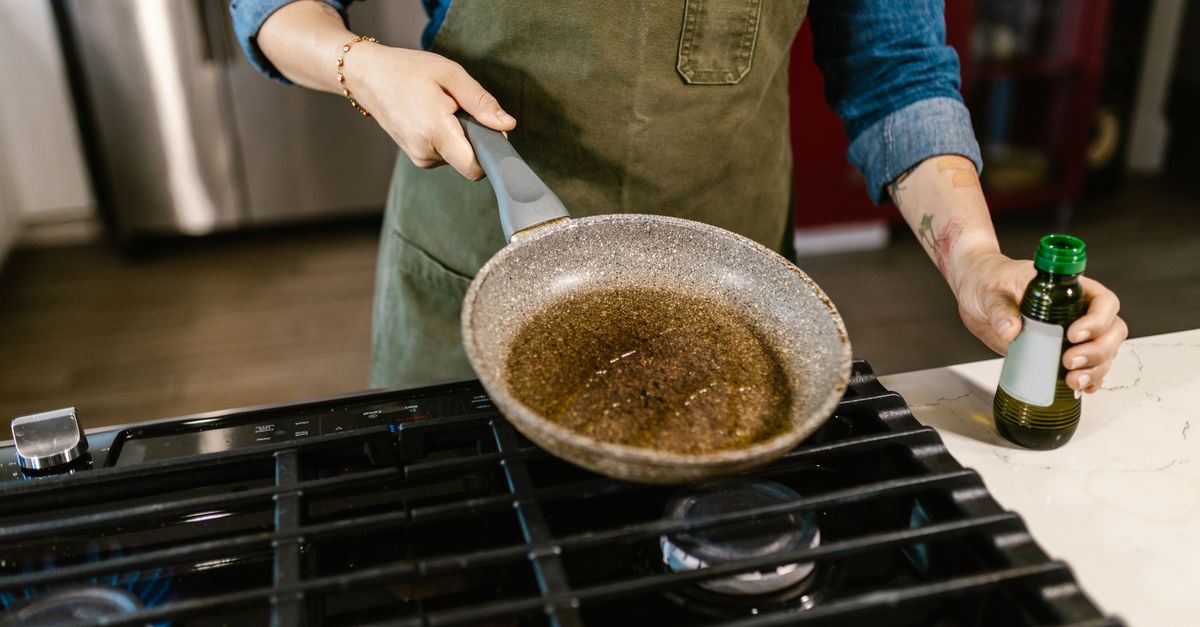
Most kitchens have too many oils and no clear idea which one to reach for. Some of that is marketing (coconut oil had a very good decade for no nutritional reason) and some of it is genuinely confusing labelling, because “vegetable oil”, “olive oil” and “rapeseed oil” each cover several products with different behaviour in the pan. The property that decides most of it is the smoke point: the temperature at which an oil stops being a cooking medium and starts breaking down.
Free PDF
Free Oven Temperature & Gas Mark Chart
A printable one-page conversion chart for your kitchen: degrees, fan, gas mark and the descriptions in between. Pop your email in and the PDF is yours, plus the odd straight-talking kitchen tip.
Free, unsubscribe any time. The download starts as soon as you sign up.
What the smoke point actually is
Heat any oil enough and it starts to decompose. The free fatty acids and any impurities in it break down into acrolein and other compounds that taste acrid, smell like a chip shop fire and are mildly irritating to breathe. The visible sign is a thin, continuous bluish smoke rising from the surface. That temperature is the smoke point.
Past it, the oil tastes burnt and its useful compounds degrade; well past it, you approach the flash point where the vapour can ignite. Nothing dramatic happens at the smoke point itself, so brief wisps when a drop hits a hot pan edge are not a crisis. Sustained smoking is your cue to take the pan off the heat.
Two things lower an oil’s smoke point in practice: impurities (which is why unrefined oils smoke earlier) and use (every round of frying creates free fatty acids, which is why oil that has fried three batches of chips smokes sooner than fresh oil).
The table
Smoke points vary by brand and batch; published figures disagree by 10 to 20°C either way. Treat these as bands, not laboratory constants.
| Oil | Smoke point | Best use |
|---|---|---|
| Refined rapeseed (canola) / “vegetable oil” | 200 to 230°C | Everyday frying, roasting, baking |
| Sunflower (refined) | 225 to 230°C | Frying, deep frying |
| Groundnut (peanut) | 230°C | Deep frying, stir frying |
| Refined olive oil (“light” / “olive oil”) | 200 to 240°C | Frying, roasting |
| Extra virgin olive oil | 190 to 210°C | Most pan cooking, dressings, finishing |
| Ghee / clarified butter | 250°C | High heat frying, curries |
| Butter (whole) | 150 to 175°C | Gentle frying, sauces, baking |
| Coconut oil (refined) | 200 to 230°C | Frying where the flavour suits |
| Coconut oil (virgin) | 175°C | Medium heat, baking |
| Avocado oil (refined) | 250 to 270°C | Searing, very high heat |
| Cold pressed rapeseed | 190 to 200°C | Medium heat, dressings |
| Sesame (toasted) | 175°C | Finishing and seasoning, not frying |
| Walnut, flaxseed, pumpkin seed | 160°C or below | Dressings and finishing only |
| Lard | 190°C | Roasting, pastry, shallow frying |
| Beef dripping | 200°C | Roast potatoes, chips |
For context: shallow frying happens around 160 to 190°C, deep frying at 170 to 190°C, a serious sear at 200°C plus. A hot oven runs 200 to 240°C, though food in it never reaches the air temperature; the oven temperature converter covers the °C, °F and gas mark equivalents.
Refined versus unrefined
This distinction explains most of the table. Refined oils have been filtered, degummed and deodorised, stripping out the particles, waxes and free fatty acids that burn early. The result is a neutral, stable oil with a high smoke point and very little flavour. Unrefined (cold pressed, virgin, extra virgin) oils keep their flavour compounds and their impurities, so they taste of something and smoke earlier.
The practical rule: refined oils for heat, unrefined oils for flavour. A refined oil in a salad dressing is a wasted opportunity; toasted sesame oil in a screaming hot wok is 175°C of burnt disappointment. Stir fry in groundnut oil, then season with a teaspoon of sesame oil off the heat.
The olive oil myth
The claim that you must never fry with extra virgin olive oil refuses to die, so here are the actual numbers. Decent extra virgin smokes around 190 to 210°C. Shallow frying happens at 160 to 190°C. There is headroom, and the entire Mediterranean has been frying in olive oil for rather a long time without incident.
The myth partly comes from confusing smoke point with oxidative stability. Extra virgin olive oil is mostly monounsaturated fat and full of antioxidants, which makes it more stable during heating than its smoke point suggests; several studies have found it holds up better in prolonged frying than seed oils with nominally higher smoke points.
The honest arguments against frying in extra virgin are cost and taste: it is expensive, and delicate, peppery notes do not survive the pan, so frying in the fancy bottle is pouring money into flavours you will never taste. Cook with a modest extra virgin or refined olive oil; save the good bottle for bread, salads and finishing. The one genuine limit is deep frying and hard searing above 200°C, where a refined oil is the better tool.
Which oils to actually own
You need three, maybe four:
- A neutral refined oil (rapeseed, sunflower or groundnut) for frying, roasting and any baking that calls for oil. If a recipe just says “oil”, it means this. Substitution questions beyond oil are covered in ingredient substitutions.
- A decent olive oil for everyday Mediterranean cooking and dressings.
- Butter, because nothing else does what butter does in baking, sauces and on toast. For high heat, clarify it or add a splash of neutral oil to raise the effective smoke point a little (mostly this works because the oil dilutes the milk solids that burn).
- One flavour oil you actually use: toasted sesame if you stir fry, a peppery extra virgin if you finish plates, walnut if you eat a lot of salads.
Everything beyond that is clutter unless you cook a cuisine that demands it. Ghee earns its place if you cook curries regularly; avocado oil is excellent but expensive for what is, in most kitchens, a marginal gain over refined rapeseed.
Storing oil so it keeps
Oil does not rot, it oxidises. Heat, light and air turn it rancid, which you can smell (crayons, old walnuts, stale cardboard) long before it becomes a health issue. Rancid oil is not dangerous in normal quantities, but it makes everything cooked in it taste stale.
- Keep oils in a cupboard, not next to the hob and not on a sunny windowsill. The worktop bottle by the cooker is convenient and it is also the fastest way to ruin oil.
- Dark glass or tins beat clear plastic.
- Refined neutral oils keep about a year unopened, six months to a year opened. Extra virgin olive oil is best within a few months of opening; buy bottle sizes you will finish. Nut oils are the fragile ones: a couple of months once opened, and the fridge extends that.
- Frying oil can be reused two or three times if you strain it through a sieve once cool and store it sealed and dark, but retire it when it darkens, smells fishy or foams, and never top up old oil with new to stretch it further.
Cloudy olive oil from the fridge or a cold room is harmless; it clears again at room temperature.
The short version
Refined oil for heat, unrefined for flavour, butter for butter reasons. Extra virgin olive oil is fine for normal frying and wasted on it financially. Keep the bottles in the dark, sniff anything old, and stop cooking when the pan smokes steadily rather than wisps.