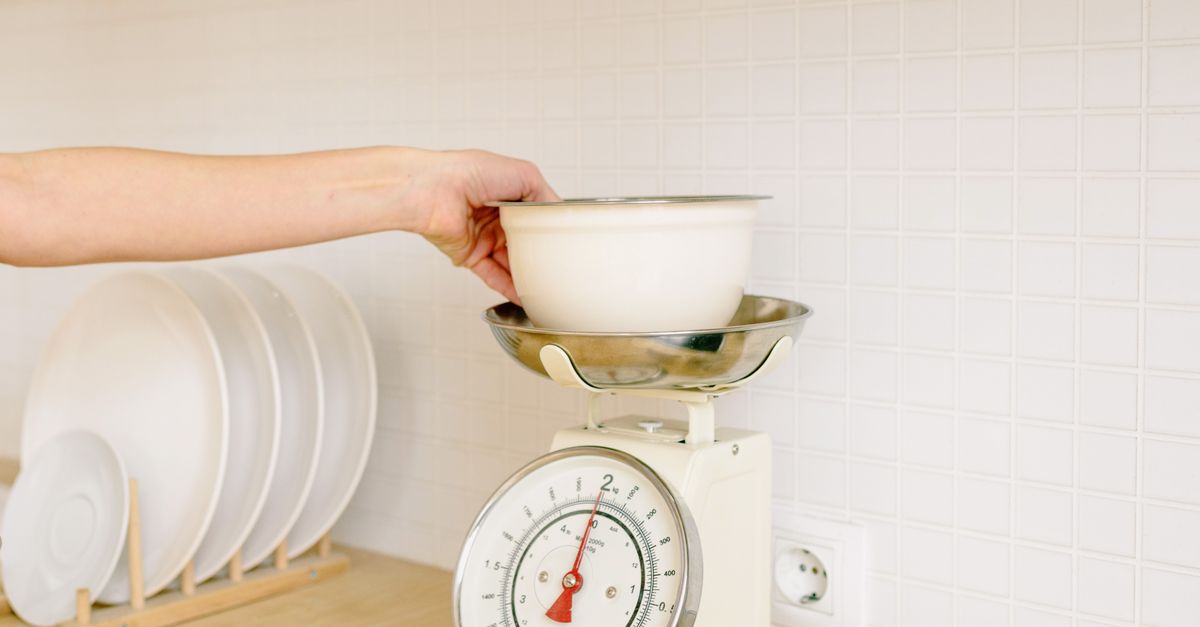
A cup of flour is not a fixed amount of flour. I learned this the hard way, years ago, making a birthday cake that came out like a paving slab because the American recipe meant one thing by “a cup” and my scooping technique meant another. I cook for a family of five, which means I cook a lot, and I have lost patience with recipes that swap between cups, ounces, grams and millilitres as if they were interchangeable. They are not. This page is the reference I wish I had kept by the hob for the last fifteen years: honest about which conversions are exact, which are approximate, and why a cheap kitchen scale will do more for your baking than any of the tables below.
Free PDF
Free Oven Temperature & Gas Mark Chart
A printable one-page conversion chart for your kitchen: degrees, fan, gas mark and the descriptions in between. Pop your email in and the PDF is yours, plus the odd straight-talking kitchen tip.
Free, unsubscribe any time. The download starts as soon as you sign up.
Buy a scale, weigh in grams
If you take one thing from this article, make it this. A digital kitchen scale costs less than a decent bag of coffee and it removes almost every conversion problem in one go.
Here is why. Grams measure mass, and mass does not change. A cup measures volume, and the amount of a dry ingredient that fits in a given volume changes with how it got there. Flour is the classic offender. Scoop the cup straight into the bag and you compress the flour; you can end up with 150 g or more in a “cup” that the recipe writer intended to hold about 125 g. Spoon the flour loosely into the cup and level it off, and you might get 115 g. That is a swing of 30 per cent on the main structural ingredient of a cake. Sugar is more forgiving because the crystals settle consistently, but flour, icing sugar, cocoa, ground almonds and grated cheese all vary badly by volume.
This matters most in baking, where ratios are chemistry. A stew will shrug off an extra 30 g of anything. A sponge will not. When people tell me their cakes are dense or their cookies spread into one giant sheet, the first question I ask is whether they weighed the flour, and the answer is almost always no.
Weighing is also faster. Put the bowl on the scale, press zero, pour, press zero, pour the next thing. No measuring cups to wash, no wondering whether butter should be packed into the cup (do not do this to yourself, ever).
The honest caveat: cups convert differently for every ingredient
Because a cup is a volume, a cup of flour, a cup of sugar and a cup of butter all weigh different amounts. There is no single “cups to grams” number, and any site that gives you one without saying which ingredient is fudging it. These are the figures I use for a 250 ml metric cup, and they are approximate by nature, because packing varies:
| Ingredient | Per 250 ml (metric) cup | Per 240 ml (US) cup |
|---|---|---|
| Plain flour, spooned and levelled | about 130 g | about 125 g |
| Caster or granulated sugar | about 210 g | about 200 g |
| Soft brown sugar, packed | about 210 g | about 200 g |
| Butter | about 225 g | 227 g (two US sticks) |
| Water or milk | 250 g | 240 g |
Water is the one exception to all this messiness. One millilitre of water weighs one gram, exactly, which is why liquid conversions are so much cleaner than dry ones. Milk is close enough to treat the same way in the kitchen. So 250 ml of milk is 250 g, and you can happily weigh your liquids straight into the bowl on the scale, which is another point in the scale’s favour.
Butter deserves a note. American recipes often give butter in sticks, and one stick is 113 g (half a US cup). Two sticks make 227 g. If your recipe says “1 stick, softened”, cut 113 g off the block and move on.
And if you get partway through a recipe and discover you are missing an ingredient entirely, no conversion will save you, but my guide to ingredient substitutions usually will.
Which cup does your recipe mean?
Here is the trap nobody warns you about: “a cup” is not one size internationally.
- A US cup is 240 ml (technically 236.6 ml, but recipe writers and US nutrition labels use 240, and the difference does not matter in cooking).
- A metric cup, which is what modern UK and most international recipes mean, is 250 ml.
- An Australian cup is also 250 ml.
- An old imperial cup, which turns up in older British recipes and some handed-down family ones, is 284 ml, half an imperial pint.
The gap between a US cup and a metric cup is only 4 per cent, which you can usually ignore. The gap between a US cup and an old imperial cup is nearly 20 per cent, which you cannot. If you are cooking from a stained handwritten card that belonged to somebody’s grandmother, or from a British cookbook printed before the 1970s, be suspicious of its cups and pints.
My rule: check where the recipe comes from before you start. American food blog, assume 240 ml. Australian or modern international, assume 250 ml. Anything old and British, assume imperial and proceed carefully.
Volume conversions: spoons, millilitres and fluid ounces
The small measures are, thankfully, mostly standardised now:
- 1 teaspoon (tsp) = 5 ml everywhere.
- 1 tablespoon (tbsp) = 15 ml in the UK and US, which is 3 teaspoons.
- 1 Australian tablespoon = 20 ml, which is 4 teaspoons. This catches people out constantly. If you are following an Australian recipe with a British tablespoon, add an extra teaspoon each time, and it matters most with strong ingredients like baking powder, yeast, salt and chilli.
- 1 dessertspoon (older British recipes) = 10 ml, two teaspoons.
Always use proper measuring spoons and level them off. The spoons in your cutlery drawer are decorative objects as far as measuring goes; I have owned “teaspoons” that held anywhere from 3 to 7 ml.
Fluid ounces are where UK and US quietly diverge again. A US fluid ounce is 29.6 ml (call it 30) and a UK fluid ounce is 28.4 ml. For a couple of fluid ounces the difference is a rounding error; over a pint it adds up, because the two pints contain different numbers of differently sized ounces:
- 1 UK pint = 20 UK fl oz = 568 ml
- 1 US pint = 16 US fl oz = 473 ml
So an American pint is about five sixths of a British one. A British recipe calling for a pint of stock wants roughly 100 ml more than an American one does. For practical purposes: half a UK pint is about 285 ml, half a US pint is about 235 ml, and a US “quart” is 946 ml, near enough a litre for soups and stocks.
Weight conversions: ounces, pounds and grams
These are exact conversions with sensible roundings, and the roundings are what real cooks actually use:
- 1 oz = 28.35 g, rounded to 25 g or 30 g in most modern British recipe conversions. Older converted cookbooks used 25 g per ounce throughout, which is why a “4 oz” sponge became a “100 g” sponge.
- 4 oz = 113 g, usually rounded to 110 g or 115 g.
- 8 oz = 227 g, usually rounded to 225 g.
- 1 lb = 454 g, rounded to 450 g. Half a pound is 225 g.
- 500 g = 1 lb 2 oz, which is why continental packs of mince and butter never quite match old British recipes.
One warning: within a single recipe, round consistently. If you convert the flour at 30 g per ounce and the butter at 25 g per ounce, you have changed the ratio, and in baking the ratio is the recipe.
Oven temperatures: Celsius, Fahrenheit and gas mark
| Gas mark | °C | °F | Description |
|---|---|---|---|
| 1 | 140 | 275 | Very low |
| 2 | 150 | 300 | Low |
| 3 | 160 | 325 | Moderately low |
| 4 | 180 | 350 | Moderate |
| 5 | 190 | 375 | Moderately hot |
| 6 | 200 | 400 | Hot |
| 7 | 220 | 425 | Hot |
| 8 | 230 | 450 | Very hot |
| 9 | 240 | 475 | Very hot |
The one everyone needs: 180°C = 350°F = gas mark 4, the standard cake and general baking temperature.
If you have a fan (convection) oven, reduce the stated temperature by about 20°C, because the moving air transfers heat faster. So a recipe written for 200°C conventional becomes about 180°C fan. Most modern recipes state both, but American recipes almost never do, since fan ovens are less common there; assume American temperatures are conventional and knock 20°C off for your fan setting. And be aware that ovens lie. Mine runs about 10°C hot, which I only discovered with a cheap oven thermometer, another purchase that pays for itself the first time it saves a batch of biscuits.
The conversions worth memorising
You do not need the whole page in your head. After years of daily cooking, these are the ones I actually use from memory:
- 1 tsp = 5 ml, 1 tbsp = 15 ml (20 ml in Australia)
- 1 US cup = 240 ml; a metric cup = 250 ml
- 1 cup of flour is roughly 125 to 130 g; 1 cup of sugar roughly 200 to 210 g
- 1 US stick of butter = 113 g
- Water and milk: 1 ml = 1 g
- 1 oz = about 28 g; 1 lb = about 450 g
- 180°C = 350°F = gas mark 4; fan ovens run about 20°C lower
Everything else, look up. That is what this page is for, and honestly, that is what my copy of it stuck inside a kitchen cupboard door is for too. For the stubborn cup measures there is now a cups to grams converter that does it by ingredient, and an oven temperature converter for the gas mark puzzles. But the deeper fix stands: weigh in grams whenever the recipe allows it, convert the stubborn cup measures with the table above, and treat every figure involving flour and a cup as an estimate rather than a promise.