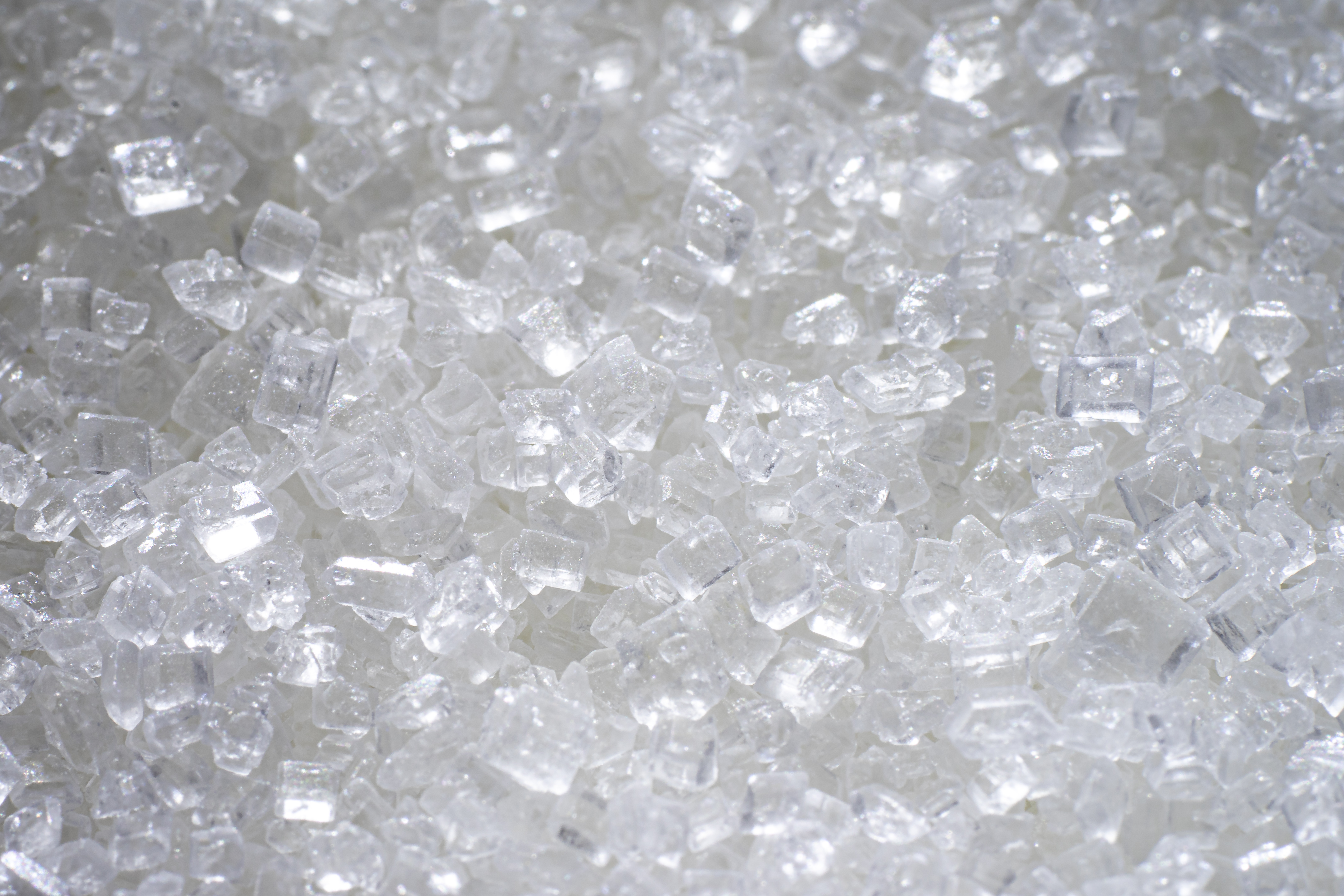
If you are mid-recipe and out of caster sugar, use granulated instead, measured one for one. It works in most bakes. The only catch is that granulated crystals are bigger and dissolve more slowly, so in the few recipes where that matters, mainly sponges and meringues, give the granulated a quick blitz in a blender first and you have caster sugar in about ten seconds. Here is when you can swap straight across, when to blitz, and the one swap to avoid.
Free PDF
Free Oven Temperature & Gas Mark Chart
A printable one-page conversion chart for your kitchen: degrees, fan, gas mark and the descriptions in between. Pop your email in and the PDF is yours, plus the odd straight-talking kitchen tip.
Free, unsubscribe any time. The download starts as soon as you sign up.
What makes caster sugar different
Caster sugar is just white sugar ground to a finer crystal than granulated. That is the whole difference, and it is also why it matters. Smaller crystals dissolve faster and pack together more evenly, which does two useful things in baking.
First, it dissolves into a batter or into egg whites quickly and completely, so you do not get a gritty result or sugar that refuses to break down. Second, when you cream butter and sugar for a cake, the fine, hard crystals cut thousands of tiny air pockets into the butter, and that trapped air is a big part of what makes a sponge rise light. Granulated does the same job, just less efficiently because the crystals are larger and fewer.
So the rule that runs through all of this: the finer and more even you can get the sugar, the closer you are to caster. Everything below comes back to that.
Granulated sugar, the straight swap
For the great majority of home baking, granulated sugar replaces caster sugar one for one and you will struggle to tell the difference. Crumbles, cookies, flapjacks, muffins, brownies, anything sturdy and forgiving: just use granulated and carry on.
Where you might notice something is in a delicate creamed sponge. Because granulated dissolves more slowly, a bake made with it can come out very slightly denser or with a faintly coarser crumb, and now and then you see tiny pale speckles on the top of a cake where sugar has not fully dissolved. It is a small effect, not a ruined bake. If you want to tilt the odds back in your favour, cream the butter and granulated sugar together for a minute or two longer than usual to give the crystals more time to break down and do their aerating work.
Blitz granulated to make your own caster
This is the trick worth knowing, because it closes the gap almost completely and takes seconds. Put granulated sugar in a clean, dry blender, food processor or spice grinder and pulse it for a few seconds until the crystals are noticeably finer. That is it. You have made caster sugar.
Two things to keep right:
- Do not overdo it. A few seconds is plenty. Keep going and you drift past caster into a fine powder heading towards icing sugar, which behaves differently, so stop while the crystals are still clearly sugar rather than dust.
- Measure after blitzing, or allow a little extra. Grinding settles the crystals so they pack tighter, which means a cupful of blitzed sugar holds slightly more sugar than a cupful of granulated did. If you are measuring by volume rather than weighing, add roughly an extra couple of teaspoons per cup to land in the right place. If you weigh your sugar, which I would always recommend for baking, this does not arise at all, because the weight is the weight whether you grind it or not. The ingredient converter will turn cups into grams if your recipe is written in cups and your scales are in grams.
Blitzed granulated is my pick whenever the recipe genuinely leans on fine sugar: a light Victoria sponge, a Swiss roll, or a meringue, where undissolved granulated crystals can make the mix weep syrup or stay grainy.
The swap to avoid: icing sugar
It is tempting, when the caster tin is empty and the icing sugar is full, to reach for the icing sugar instead. Do not. Icing sugar is not caster sugar ground a bit finer; it is ground to a flour-fine powder and usually has a small amount of anti-caking agent mixed in to stop it clumping. Swap it in for caster and you change both the texture and the way the sugar behaves.
In a creamed cake it will not trap air the way crystal sugar does, so you lose some of the lift and the crumb turns tight and sometimes greasy. In a meringue it dissolves too fast and too completely to build the same stable structure. The results range from disappointing to genuinely wrong, so treat icing sugar and caster sugar as two different ingredients that are not interchangeable. If icing sugar is all you have and the bake truly needs caster, you are better off blitzing granulated, or even using granulated straight, than reaching for the icing sugar.
Golden caster sugar
If you have golden caster sugar but no white, go ahead and use it one for one. It is unrefined caster sugar, so it carries a faint toffee or butterscotch note and a light golden colour. In most bakes that is either unnoticeable or quietly nice. The only time to pause is where a pure white colour is the point, such as a pale meringue or a delicate icing, because golden caster will tint it very slightly. For everything else it is a straight swap.
Why I weigh sugar rather than scoop it
A lot of the trouble with sugar swaps comes down to how you measure. A cup of granulated and a cup of caster do not hold the same amount of sugar by weight, because the finer crystals settle and pack differently, so a recipe written in cups can quietly drift when you change which sugar you use. If you weigh in grams, the swap is far more honest: 100g of sugar is 100g whether it is caster, granulated or blitzed, and the recipe stays in balance. A set of digital scales costs very little and takes the guesswork out of every one of these substitutions. If your recipe is in cups and you would rather convert it once and weigh from then on, the ingredient converter does the sum.
One last case where the crystal size genuinely matters is anything no-bake: a cheesecake filling, a cold cream, a drink that will not go near heat. With no oven and no long mixing to help the sugar dissolve, large granulated crystals can stay gritty, so this is another spot to blitz the sugar first or to reach for proper caster if you have it.
What about brown sugar or honey?
These are not caster sugar substitutes in the measure-for-measure sense, because they change the recipe. Soft brown sugar brings moisture and a treacle flavour and makes bakes chewier and darker, which is wonderful in cookies and a problem in a pale sponge. Honey and syrups add liquid, so you cannot swap them for a dry sugar without rebalancing the recipe. If brown sugar is genuinely all you have, it will make something edible, just expect a different, denser, darker bake rather than the one in the photo.
The short version
- Granulated: swap one for one for most bakes. Cream a little longer for sponges.
- Granulated, blitzed a few seconds: the closest match, and what to use for meringues and light sponges.
- Golden caster: one for one, with a faint colour and flavour change.
- Icing sugar: not a substitute, so leave it in the cupboard.
- Brown sugar or honey: only in a pinch, and expect a different result.
For the rest of the baking cupboard swaps, from buttermilk to self-raising flour, the baking ingredient substitutions guide has them gathered in one place, and if you are scaling a recipe up or down the recipe scaler keeps the sugar in proportion with everything else.